
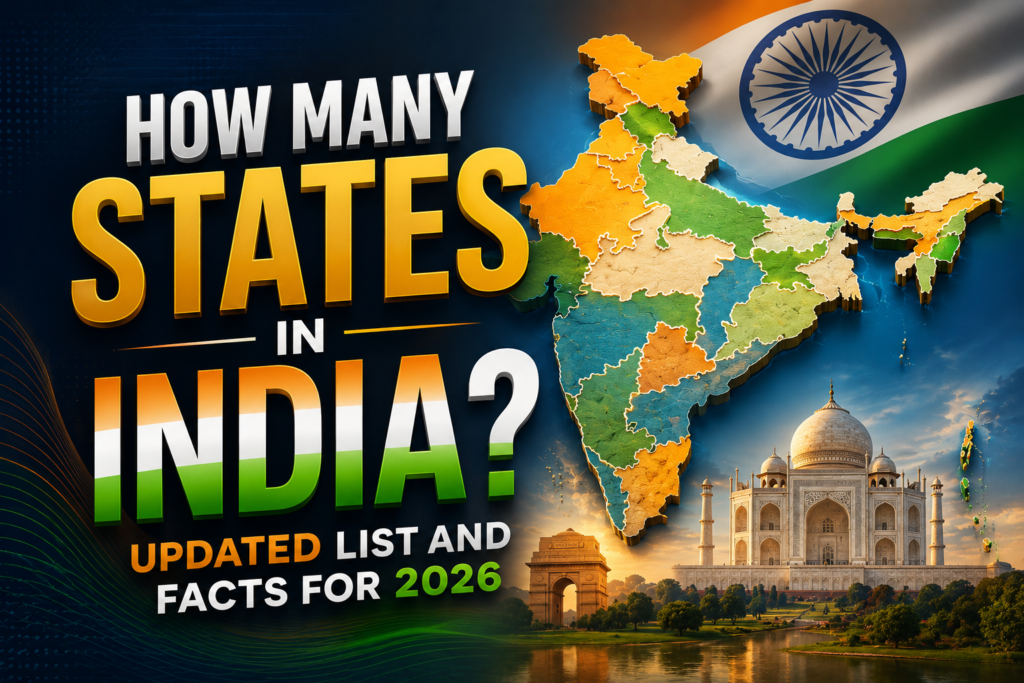
If you are planning a trip, studying for competitive exams like UPSC, or simply curious about the world’s most populous country, knowing the exact administrative layout of India is essential. Over the last few years, major geopolitical realignments have left many people wondering about the exact count of subnational entities on the Indian map.
So, how many states in India are there today?
As of 2026, India comprises exactly 28 states and 8 union territories (UTs), making a total of 36 administrative entities.
This structure has remained stable since the central government restructured the former state of Jammu and Kashmir into two distinct union territories and later merged Dadra and Nagar Haveli with Daman and Diu. Below, we break down the definitive, updated list of all 28 states, their respective capitals, official languages, and key geographical insights.
Complete List of the 28 States and Capitals of India (Updated 2026)
The Indian subcontinent functions as a federal constitutional republic governed under a parliamentary system patterned on the Westminster model. Each state maintains its own elected legislative assembly and local government headed by a Chief Minister.
The table below provides a comprehensive, scannable overview of all 28 states, their executive capitals, key official languages, and the year they were established or integrated into the federal union.
| S.No. | State | Capital | Primary Official Language(s) | Establishment Year |
| 1 | Andhra Pradesh | Amaravati | Telugu | 1956 |
| 2 | Arunachal Pradesh | Itanagar | English | 1987 |
| 3 | Assam | Dispur | Assamese, Boro | 1950 |
| 4 | Bihar | Patna | Hindi, Urdu | 1950 |
| 5 | Chhattisgarh | Raipur | Hindi, Chhattisgarhi | 2000 |
| 6 | Goa | Panaji | Konkani | 1987 |
| 7 | Gujarat | Gandhinagar | Gujarati | 1960 |
| 8 | Haryana | Chandigarh | Hindi | 1966 |
| 9 | Himachal Pradesh | Shimla (Summer) / Dharamshala (Winter) | Hindi | 1971 |
| 10 | Jharkhand | Ranchi | Hindi | 2000 |
| 11 | Karnataka | Bengaluru | Kannada | 1956 |
| 12 | Kerala | Thiruvananthapuram | Malayalam | 1956 |
| 13 | Madhya Pradesh | Bhopal | Hindi | 1956 |
| 14 | Maharashtra | Mumbai (Summer) / Nagpur (Winter) | Marathi | 1960 |
| 15 | Manipur | Imphal | Meitei (Manipuri) | 1972 |
| 16 | Meghalaya | Shillong | Khasi, Garo, English | 1972 |
| 17 | Mizoram | Aizawl | Mizo, English | 1987 |
| 18 | Nagaland | Kohima | English | 1963 |
| 19 | Odisha | Bhubaneswar | Odia | 1950 |
| 20 | Punjab | Chandigarh | Punjabi | 1956 |
| 21 | Rajasthan | Jaipur | Hindi | 1956 |
| 22 | Sikkim | Gangtok | Nepali, Sikkimese | 1975 |
| 23 | Tamil Nadu | Chennai | Tamil | 1956 |
| 24 | Telangana | Hyderabad | Telugu, Urdu | 2014 |
| 25 | Tripura | Agartala | Bengali, English, Kokborok | 1972 |
| 26 | Uttar Pradesh | Lucknow | Hindi, Urdu | 1950 |
| 27 | Uttarakhand | Dehradun (Winter) / Gairsain (Summer) | Hindi, Sanskrit | 2000 |
| 28 | West Bengal | Kolkata | Bengali | 1956 |
List of 8 Union Territories and Their Capitals
Unlike states, which enjoy a high degree of administrative autonomy, Union Territories are direct administrative subdivisions under the central union government. They are overseen by an administrator or Lieutenant Governor appointed by the President of India.
However, there are unique exceptions: the National Capital Territory (NCT) of Delhi, Puducherry, and Jammu and Kashmir have been granted partial statehood features, complete with elected legislative assemblies.
- Andaman and Nicobar Islands: Port Blair (Established 1956)
- Chandigarh: Chandigarh (Established 1966 — serves as the shared capital city for both Punjab and Haryana)
- Dadra and Nagar Haveli and Daman and Diu: Daman (Merged into a single entity in 2020)
- Delhi (NCT): New Delhi (National Capital Territory)
- Jammu and Kashmir: Srinagar (Summer Capital) / Jammu (Winter Capital)
- Ladakh: Leh (Bifurcated from J&K)
- Lakshadweep: Kavaratti (India’s smallest UT by land area)
- Puducherry: Puducherry (Formerly known as Pondicherry)
The Geopolitical Milestones: Why Did the Number Change?
If your school textbooks recall a different number — such as 29 states — you are not alone. The internal borders of the country have undergone massive administrative evolutions to streamline governance and address ethnic, cultural, or logistical demands.
More blogs : Mortgage Recast Calculator
The Creation of Telangana (2014)
In June 2014, the state of Andhra Pradesh was bifurcated, leading to the creation of India’s 29th state: Telangana. For a decade, Hyderabad functioned as the joint capital of both regions. Today, Amaravati is transitioning into the fully independent seat of power for Andhra Pradesh.
The Reorganization of Jammu and Kashmir (2019)
The most profound shift occurred in October 2019. The central union government repealed Article 370, effectively ending the special autonomous status of Jammu and Kashmir. The territory was stripped of its statehood status and split into two distinct Union Territories: Jammu & Kashmir and the high-altitude region of Ladakh. This historic administrative pivot immediately brought the state count back down from 29 to 28.
The UT Merger of 2020
To eliminate bureaucratic redundancy and optimize local government spending, the Parliament passed legislation to merge the two separate western coastal territories of Dadra and Nagar Haveli and Daman and Diu. Taking effect on January 26, 2020, this merger settled the union territory tally to its current figure of 8.
Key Geographical Facts and Extremes About Indian States
India spans over 3.28 million square kilometers, making it the seventh-largest country by area worldwide. Its internal geography offers mind-boggling scale and contrasts.
More Info : fintechzom.blog – Where Innovation Meets Insight
The Giants: Largest States by Area and Population
Largest State (Area): Rajasthan (342,239 sq km) ➔ Larger than Germany
Most Populous State: Uttar Pradesh (Estimated ~240 million residents) ➔ Equal to the population of Brazil
- Rajasthan: Dominating the northwestern flank with the vast Thar Desert, Rajasthan is the largest state by geographic area.
- Uttar Pradesh: Located in the fertile Indo-Gangetic plains, Uttar Pradesh holds the record as the most populous state. If it were an independent nation, it would rank as the world’s fifth most populous country.
The Smallest Entities on the Map
- Goa: Situated on the southwestern Malabar Coast, Goa is renowned for its global tourism footprint, yet it remains the smallest state by land surface area, spanning a mere 3,702 square kilometers.
- Sikkim: Tucked away in the eastern Himalayan range, Sikkim is the least populous state in India. It is a pioneer in eco-conservation, celebrated worldwide as the planet’s first 100% organic farming territory.
Understanding the Regional Divisions of India
To easily process the staggering diversity across around 800 administrative districts, geographers and census boards categorize the 28 states into five principal regions.
1. Northern India
Characterized by towering mountain systems and ancestral rivers, this belt features Himachal Pradesh, Punjab, Uttarakhand, Haryana, and Rajasthan, alongside the territories of Delhi, J&K, and Ladakh. It forms the historic and political nucleus of the country.
2. Southern India
Bordered by the Arabian Sea and the Bay of Bengal, the south boasts immense economic strength. It comprises Andhra Pradesh, Karnataka, Kerala, Tamil Nadu, and Telangana. This region is globally distinct for its ancient Dravidian architecture, high literacy indexes, and modern technology hubs like Bengaluru.
3. Eastern and Central India
The mineral heartland of the subcontinent includes Bihar, Jharkhand, Odisha, and West Bengal, transitioning into the core central states of Madhya Pradesh and Chhattisgarh. This belt holds the country’s largest concentration of heavy manufacturing industries and ancient tribal heritages.
4. Western India
Driven heavily by commerce, industrialization, and major shipping ports, the west is comprised of Gujarat and Maharashtra, alongside the pocket state of Goa. Mumbai, the capital of Maharashtra, stands proud as India’s financial and entertainment engine.
5. Northeastern India (The Seven Sisters + Sikkim)
Geographically connected to the rest of the mainland by the narrow Siliguri Corridor, the northeast is an paradise of biodiversity and tribal cultures. It features the famous “Seven Sister States”:
- Arunachal Pradesh
- Assam (famous for producing more than half of India’s tea)
- Manipur
- Meghalaya (home to Mawsynram, the wettest place on Earth)
- Mizoram
- Nagaland
- Tripura
Conclusion
Navigating the administrative map of India reveals a dynamic balance of cultural preservation and modern structural optimization. By cementing the tally at 28 states and 8 union territories, the federal system maintains stable governance over 1.47 billion people. Keeping track of these boundaries is highly beneficial, whether you are preparing for civil service exams or keeping up with global geopolitics.
Frequently Asked Questions (FAQs)
How many states and union territories are there in India in 2026?
India has 28 states and 8 union territories, totaling 36 distinct administrative entities.
Which is the largest and smallest state in India by area?
Rajasthan is the largest state by total land area, while Goa is the smallest.
What is the national capital of India?
New Delhi is the official national capital of India, operating as a distinct union territory.
Which Indian state has two capitals?
Jammu and Kashmir (UT), Himachal Pradesh, and Uttarakhand utilize dual capital cities to optimize governance during seasonal winter shifts.
Which state was the last to be formed in India?
Telangana is the youngest state in the union, officially established on June 2, 2014.