
IP address geolocation has quietly become one of the internet’s most relied-upon tools. It powers content localization, fraud detection, regulatory compliance, and CDN routing — all from a single signal: your IP Address Location.
But the ecosystem is changing fast. By 2026, a combination of IPv6 adoption, AI-driven accuracy improvements, tightening privacy laws, and rising VPN usage is forcing the entire field to evolve. If you’re a developer, security professional, or business relying on IP location data, here’s exactly what’s shifting — and why it matters.
What Is IP Address Geolocation (And Why It’s Imperfect Today)?
IP geolocation maps an IP address to a physical location — country, region, city, or timezone — using databases compiled from multiple sources including WHOIS records, geofeeds, BGP routing data, and reverse DNS lookups.
The core problem? These databases go stale. IP address ranges get reassigned, ISPs expand into new regions, and many providers rely on data that’s weeks or months out of date. The result is a predictable pattern of failures:
- IP ranges labeled too broadly (country-level instead of city-level)
- Leased IP space with conflicting ownership claims
- VPN traffic masking the user’s real location entirely
- IPv6 blocks with far less historical data than IPv4
Country-level accuracy is generally reliable for compliance purposes, but city-level precision — the kind needed for fraud prevention, personalized UX, or CDN steering — remains inconsistent across providers.
The IPv6 Transition: The Biggest Structural Shift in IP Geolocation
IPv6 is the most significant infrastructure change affecting IP location technology today.
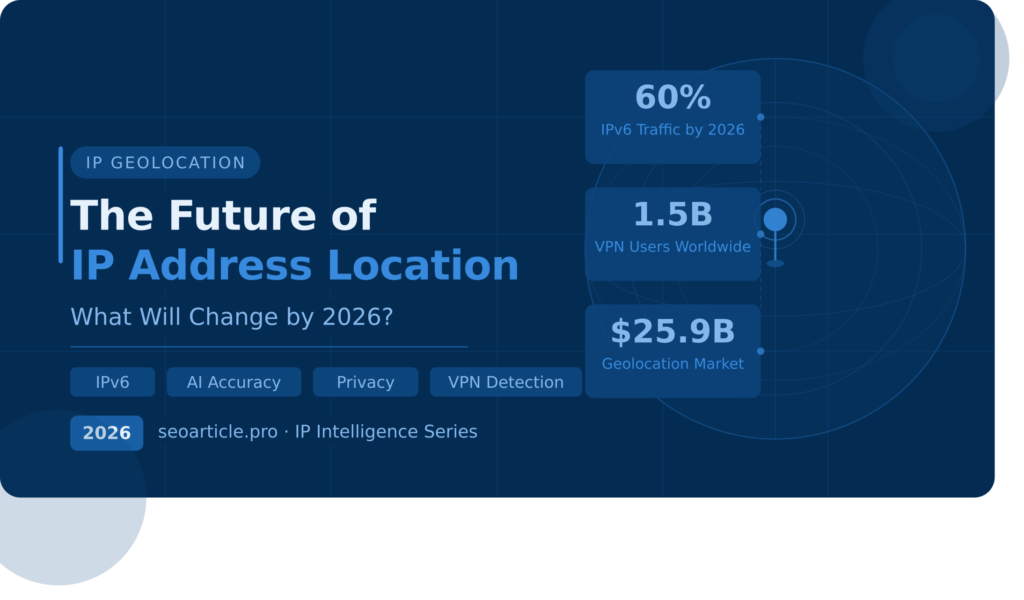
IPv4, which underpins most of the internet’s addressing system, has been exhausted at the regional registry level for years. IPv6 adoption has been climbing steadily — and by 2026, IPv6 traffic is expected to account for over 60% of internet traffic globally, according to JoshWP’s geolocation database analysis.
What This Means for Geolocation Accuracy
| Factor | IPv4 | IPv6 |
|---|---|---|
| Address space | ~4.3 billion addresses | 340 undecillion addresses |
| Geolocation database maturity | Decades of data | Still maturing |
| City-level accuracy | Relatively strong | Weaker in developing regions |
| Assignment patterns | Mostly static blocks | More dynamic, larger ranges |
| Current coverage | Dominant in enterprise/fixed line | 40–50%+ capability globally |
As of 2025, APNIC reported global IPv6 capability at roughly 40–45%, with the Asia-Pacific region exceeding 50%. The challenge for geolocation providers is that IPv6 databases simply have less historical data to draw from — which directly affects accuracy in those regions.
The opportunity, however, is significant. IPv6’s vastly larger address space means ISPs may assign more stable, geographically coherent blocks — potentially improving long-term location precision once the data matures.
How AI and Machine Learning Are Redefining Location Precision
The most transformative force in IP geolocation right now isn’t hardware — it’s algorithms.
Machine learning systems are being deployed across geolocation pipelines to:
- Analyze large-scale network traffic patterns and identify geographic anomalies
- Cross-reference multiple data sources simultaneously (BGP paths, DNS records, latency measurements, geofeeds)
- Adapt dynamically as IP assignments change, reducing the staleness problem
- Detect VPNs, proxies, and datacenter traffic with significantly higher accuracy than rule-based systems
Companies like IPinfo are already using active measurement networks — systems that ping IP infrastructure from dozens of global vantage points — to validate geolocation data in real time rather than relying purely on static database records. This approach moves the field from “best-effort guess” toward verified, dynamic location intelligence.
The practical impact: fraud prevention and security applications saw 31% growth as the fastest-rising geolocation use case through 2025, partly because ML-powered systems can now catch anomalies that traditional databases miss.
The VPN Problem: A Growing Blind Spot
One of the most disruptive trends for IP geolocation is the explosion of VPN usage.
When a user connects through a VPN, their traffic exits from a server that may be in a completely different country. As of 2025, approximately 1.5 billion internet users — roughly one-third of all users globally — connect through VPNs regularly. That means a substantial share of any website’s traffic will geolocate to a VPN endpoint, not the user’s actual location.
This creates real business problems:
- Content licensing failures — streaming platforms like Netflix geoblock content based on IP; VPNs circumvent this
- Fraud false negatives — bad actors use VPNs to appear as legitimate geographic locations
- Compliance gaps — GDPR and CCPA protections triggered by wrong-region IPs
- Analytics distortion — traffic from a VPN server in Frankfurt may actually originate from São Paulo
The industry response has been to build VPN and proxy detection as a first-class feature alongside standard geolocation. By 2026, any serious geolocation provider must include connection-type classification — distinguishing residential, mobile, datacenter, VPN, and proxy traffic — not just coordinates.
Geofeeds: A Promising but Underutilized Standard
One technically sound solution to IP geolocation inaccuracy is geofeeds — machine-readable files that ISPs and network operators publish to self-declare the geographic location of their IP ranges.
The RFC 8805/9092 standard provides a standardized format for these feeds. The core promise is powerful: if the IP block owner tells the world where their IPs actually are, the guesswork disappears.
The reality is more complicated. Adoption remains extremely limited. Analyses have found that only a small fraction of announced IP addresses are covered by published geofeeds, and a percentage of those that do exist contain errors at the client, router, or server level.
Still, when properly implemented, geofeeds offer a systematic path to accuracy. Expect adoption to increase through 2026 as geolocation providers incentivize ISPs to publish them and as tooling improves. Providers who actively cross-reference geofeed data with their own measurements will have a structural accuracy advantage.
Privacy Regulations Are Reshaping What’s Permissible
IP address geolocation exists at a direct intersection with data privacy law. And that intersection is getting more complex.
Key Regulatory Pressures by 2026
GDPR (EU): IP addresses are classified as personal data under GDPR. Using IP-based location to identify individual users without proper legal basis can trigger compliance violations. Geolocation providers are responding by offering aggregated location data, on-device processing options, and differential privacy techniques that preserve utility at the population level without exposing individuals.
CCPA (California): Similar constraints apply to California residents. Businesses using IP data for ad targeting or profiling must provide opt-out mechanisms.
Emerging regulations: Countries across Southeast Asia, Latin America, and Africa are introducing their own data protection frameworks — each with varying definitions of what IP-based tracking requires in terms of consent.
The practical result: geolocation APIs are evolving toward privacy-by-design architectures. Features like anonymized location buckets, consent-aware lookup modes, and regional data routing are moving from “nice to have” to contractual requirements.
More Info You Can Read : Instant IP Address Lookup
Real-World Use Cases Driving Demand Through 2026
Despite accuracy and privacy challenges, demand for IP geolocation is growing. The global location-based services market is projected to expand from $15.7 billion in 2024 to $25.9 billion in the near term, driven by several compounding forces:
- Fraud prevention: Real-time geofencing that flags login attempts from unusual geographies — particularly valuable for financial services and e-commerce
- Content personalization: Delivering localized language, pricing, and product availability based on user region without requiring login
- Regulatory compliance: Automatically enforcing GDPR consent banners, age verification, and sanctions screening at the IP level
- CDN optimization: Routing users to the nearest edge server to reduce latency and improve performance
- IoT device management: Geolocation for billions of connected devices that don’t carry traditional user identifiers
What the IP Geolocation Landscape Looks Like in 2026
The competitive dynamics among providers are tightening. Several key patterns are clear:
- Daily database updates are now the baseline standard — anything less means working with stale data during critical IP reassignment windows
- Security signal layers — VPN detection, proxy classification, ASN intelligence, and threat scoring are increasingly bundled with core location data
- IPv6-specific coverage is now a differentiating factor; providers with weak IPv6 mapping have growing blind spots
- Active measurement (probing infrastructure directly) is outperforming passive database-only approaches for city-level accuracy
Conclusion
IP address location technology is in the middle of a genuine transformation. The shift to IPv6 is the infrastructure forcing function. AI and active measurement are the accuracy solutions. VPN proliferation and privacy regulations are the constraints.
By 2026, the field will look meaningfully different: geolocation data will be fresher, more verified, and enriched with security signals that simple address-to-coordinate mapping never provided. Businesses that treat IP location as a legacy static lookup are already falling behind. Those building on dynamic, ML-enhanced, privacy-aware APIs are positioned to stay accurate even as the internet’s architecture continues to change.
FAQs
What is IP address geolocation?
IP address geolocation is the process of mapping an IP address to a physical location — such as country, city, or timezone — using databases compiled from network registration records, geofeeds, and routing data.
How accurate is IP geolocation in 2026?
Country-level accuracy is consistently high (95%+), but city-level accuracy varies significantly by provider and region, especially for IPv6 addresses in developing markets.
Can a VPN fool IP geolocation?
Yes — VPNs route traffic through servers in different locations, causing geolocation to return the VPN server’s location rather than the user’s real one. Modern providers now include VPN detection as a core feature.
What is an IP geofeed?
A geofeed is a machine-readable file published by ISPs or network operators that declares the physical location of their IP address ranges, allowing geolocation services to use verified, self-reported location data.
Why is IPv6 a challenge for geolocation?
IPv6’s much larger address space and more dynamic allocation patterns mean geolocation databases have far less historical data to draw on compared to IPv4, reducing accuracy — particularly in regions with high IPv6 adoption.
Is IP geolocation legal under GDPR?
IP addresses are considered personal data under GDPR. Using them for geolocation requires a lawful basis and appropriate privacy controls, especially when tracking individual users.
What is the most common use case for IP geolocation in 2026?
Fraud prevention and security is the fastest-growing use case, followed closely by content localization, regulatory compliance, and CDN traffic optimization.