
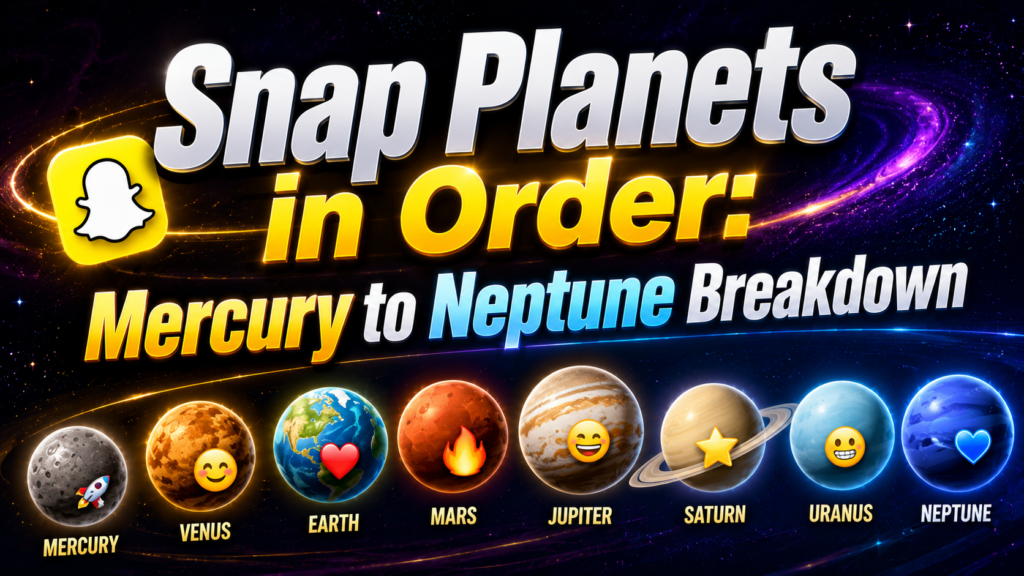
Social media interactions have evolved past basic, static lists of contacts. Modern digital communication networks rely on advanced gamification to map your network connections. For premium communication enthusiasts, nothing illustrates this quite like the specialized Friend Solar System feature. Understanding the exact arrangement of the Snap planets in order: Mercury to Neptune breakdown allows active subscribers to clearly decipher their interpersonal data streams. Exclusive to Snapchat Plus, this system assigns visual planetary identifiers to your top eight contacts based on back-and-forth messaging data, voice metrics, and streak frequencies.
By translating complex data logs into a cosmic layout, the platform lets you track who orbits closest to your digital sun. However, because the backend ranking system relies on dynamic activity rather than permanent slots, user positions change constantly.
Whether you want to decode the specific color themes of a specialized badge or figure out why a contact slipped down your ranking list, this 2026 master guide breaks down every planet in the Snapchat hierarchy.
More Blogs : fintechzom.blog – Where Innovation Meets Insight
How the Snapchat Plus Friend Solar System Operates
Before diving into individual planet details, you need to understand the structural logic behind the algorithm. The Snapchat Friend Solar System takes your internal “Best Friends” data and wraps it in a solar system theme.
In this structure, you act as the Sun at the absolute center of the universe. The eight contacts you share the highest volume of mutual interaction with populate the surrounding orbits.
           [ The Sun ] (Your Profile Core)
                │
  ┌───────┬─────┴─────┬───────┐
  ▼       ▼           ▼       ▼
Mercury Venus       Earth   Mars ... [Neptune]
(Rank 1) (Rank 2)   (Rank 3) (Rank 4) ... (Rank 8)
Core Mathematical Rules to Keep in Mind:
- Relative Rankings: The platform does not calculate a flat, unchanging point value. Your placement depends entirely on how much someone interacts with you relative to everyone else on their list.
- Opt-In Visibility: To protect user well-being and alleviate social anxiety, Snapchat sets this feature to off by default. You must manually activate it inside your profile configuration settings.
- The Badge Delta: Tapping a user’s profile badge reveals your position. A “Best Friends” gold ring means you are both in each other’s top eight lists, while a standard “Friends” tag means the ranking is one-sided.
The Complete Snap Planets in Order Breakdown
The system mirrors the actual astronomical paths of our solar system. As you move farther from the Sun, interaction metrics decrease. Here is the official layout from the closest orbit out to the edge of the universe.
More Blogs : Mortgage Recast Calculator
1. Mercury (The Number 1 Best Friend)
- Visual Presentation: A distinct brassy orange, pink, and grey sphere adorned with bright red hearts and floating star clusters.
- Algorithmic Meaning: This spot belongs to your absolute ride-or-die contact. This user represents your highest volume of sent and received multimedia snaps, immediate text responses, and active voice calls.
2. Venus (The Second Closest Best Friend)
- Visual Presentation: A light brown or pale yellow-beige marbled sphere surrounded by a mix of light blue, yellow, and pink hearts.
- Algorithmic Meaning: This contact is incredibly close to breaking into your top spot. Your daily communication with them is highly consistent, often trailing your primary best friend by a very slim margin.
3. Earth (The Third Closest Best Friend)
- Visual Presentation: An instantly recognizable blue and green globe featuring visible continents, oceans, red hearts, and a tiny accompanying moon graphic.
- Algorithmic Meaning: This position represents a highly stable, reliable friendship. You likely share long-running streaks or engage in daily conversation threads that keep this contact firmly locked in your top three.
4. Mars (The Fourth Closest Best Friend)
- Visual Presentation: A deep red, heavily cratered planet floating alongside purple and dark blue heart accents.
- Algorithmic Meaning: This spot signals a highly energetic, casual bond. While you talk to this person frequently, your message volume lacks the heavy, continuous pace needed to break into the inner tier.
5. Jupiter (The Fifth Closest Best Friend)
- Visual Presentation: A large, imposing orange-red planet sporting horizontal dark stripes and a cluster of gold stars, notably lacking heart icons.
- Algorithmic Meaning: This rank indicates a highly comfortable, steady interaction level. You stay in touch often enough to remain ranked, though your communication lacks intense, around-the-clock frequency.
6. Saturn (The Sixth Closest Best Friend)
- Visual Presentation: A yellow-orange planet wrapped inside a massive, highly visible horizontal ring system with surrounding star arrays.
- Algorithmic Meaning: This tier represents a casual relationship loop. You drop into each other’s direct messages regularly, but minor shifts in overall activity can easily push this planet further out.
7. Uranus (The Seventh Closest Best Friend)
- Visual Presentation: A smooth, solid light green-blue swirled planet with vertical spiral bands and minimalist star accents.
- Algorithmic Meaning: This orbit marks the beginning of the outer edges of your inner circle. Conversations here happen periodically rather than daily, usually consisting of occasional group chat check-ins or shared content updates.
8. Neptune (The Eighth Closest Best Friend)
- Visual Presentation: A deep, solid dark blue sphere floating out in the cold, quiet edges of the solar system matrix.
- Algorithmic Meaning: This is the absolute boundary of your top list. This user cracks your top eight, but your overall engagement level with them remains low compared to your primary contacts.
Comparing the Snap Planet Hierarchy at a Glance
Because scanning through multiple visual descriptions can get confusing when you are actively checking your app interface, a structured view helps clarify the system layout.
The following data matrix offers a quick reference guide to matching the planet names with their rank and appearance:
| Solar Position | Planet Asset Name | Primary Base Colors | Graphic Accents Included | System Ranking Tier |
| Position 1 | Mercury | Brassy Orange / Pink | Red Hearts & Gold Stars | #1 Best Friend |
| Position 2 | Venus | Beige / Pale Brown | Pink, Blue & Yellow Hearts | #2 Best Friend |
| Position 3 | Earth | Vibrant Blue / Green | Red Hearts & Mini Moon | #3 Best Friend |
| Position 4 | Mars | Crimson Red | Purple & Navy Blue Hearts | #4 Best Friend |
| Position 5 | Jupiter | Striped Dark Orange | Bright Gold Stars (No Hearts) | #5 Best Friend |
| Position 6 | Saturn | Yellow-Gold | Large Ring System & Stars | #6 Best Friend |
| Position 7 | Uranus | Light Green-Blue | Vertical Lines & Stars | #7 Best Friend |
| Position 8 | Neptune | Deep Space Blue | Clean, Isolated Cold Sphere | #8 Best Friend |
Why Do Snap Planet Rankings Shift Unexpectedly?
A common source of confusion for premium subscribers is watching a friend suddenly drop from Earth down to Saturn without any drop-off in communication. This occurs because the feature evaluates your entire network simultaneously.
“A planet position does not reflect a fixed mathematical score. It represents your active rank compared to all other active users on a person’s list at that exact moment.” — Platform Architecture Insight
If your friend starts messaging a new contact at an incredibly intense pace, that new user will take over the Mercury spot. As a result, everyone else on their list automatically gets pushed outward by one slot, even if your personal daily message volume with them stayed exactly the same.
Conclusion
Tracking Snap planets in order: Mercury to Neptune breakdown provides an insightful, data-driven look at your social circles on Snapchat Plus. By translating your messaging frequency into a clear, visual solar system layout, the app makes analyzing your network engagement easy. Keep your communication natural, focus on meaningful interactions, and remember that these digital orbits change alongside your everyday habits.
Frequently Asked Questions (FAQs)
What is the exact order of the Snap planets?
The official order flows from closest to farthest: Mercury, Venus, Earth, Mars, Jupiter, Saturn, Uranus, and Neptune.
Which planet represents my number one best friend on Snapchat?
Mercury represents your top-ranked best friend, appearing as a brassy orange and pink planet with bright red hearts.
Why can’t I see the planet system on my active account?
The feature requires a paid Snapchat Plus subscription and must be manually toggled on from your feature management screen.
Can my contacts see my entire planet ranking array?
No, your personal solar system configuration remains entirely private; other users can only see their own individual placement.
Do text chats count toward moving a planet closer to the Sun?
Yes, the backend algorithm analyzes text messages, multimedia snaps, and direct voice calls to determine relationship closeness.
What does the Earth badge mean in the app?
Seeing the Earth asset indicates that you are ranked as that user’s third closest friend within their network.