
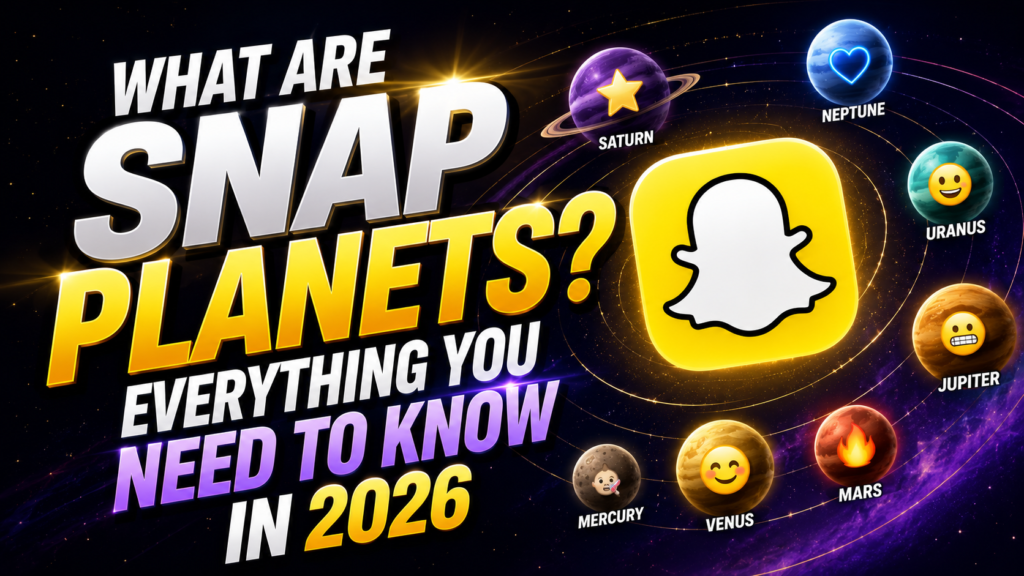
Social media platforms are constantly finding new ways to quantify and visualize our real-world relationships. Few features have captured the fascination of the digital generation quite like Snapchat’s cosmic friendship tracking system. If you have been browsing through premium app settings lately, you have probably wondered: What Are Snap Planets? In 2026, this feature remains a highly discussed perk of the Snapchat Plus paid subscription service. Formally known as Friend Solar Systems, this unique feature turns your closest inner circle into a virtual galaxy, assigning planetary roles to your top eight friends based on communication habits.
By blending gamified friendship milestones with augmented reality aesthetic overlays, the feature allows users to see exactly where they stand in their friends’ communication loops. However, because it calculates highly dynamic social data, it has sparked plenty of curiosity and technical questions.
Whether you are trying to understand why your planetary position suddenly shifted overnight, or you are deciding if upgrading to a premium account is worth it, this ultimate guide breaks down everything you need to know about the current mechanics of Snap Planets.
The Concept Behind Snapchat Friend Solar Systems
At its core, the Snapchat Planet feature is a visual redesign of the platform’s classic “Best Friends” list. Instead of showing a boring, text-based numbered index of the people you interact with most, the app uses a solar system theme to represent these connections.
            [ The Sun ] (Your Friend's Profile)
                 │
  ┌───────┬──────┼───────┬───────┐
  ▼       ▼      ▼       ▼       ▼
Mercury Venus  Earth   Mars   ...and so on (Top 8 Friends)
(Bestie) (#2)   (#3)    (#4)
In this digital universe, the profile you are viewing acts as the Sun. You, as the subscriber checking the status, are assigned a specific planet orbiting that sun. Your placement depends entirely on your relative interaction level with that person compared to their other contacts.
Key Mechanics of the System:
- Exclusivity: Viewing the planet system requires an active paid subscription to Snapchat Plus.
- Privacy Controls: Your personalized solar system layout is completely hidden from the public eye. Other users cannot see your entire list; they can only check their own individual placement when viewing your profile badge.
- Relative Metrics: The system does not look at a flat numerical score. Instead, it measures your communication frequency against all other users on that friend’s list.
The Official Snapchat Planet Order and Meanings
To interpret your placement accurately, you must understand the real-world order of the planets moving outward from the Sun. The closer your assigned planet sits to their central sun, the higher your interaction status is on their profile.
The following structured table maps out the official 2026 planetary hierarchy, complete with the visual markers used inside the application interface:
| Rank Placement | Assigned Planet | Visual Appearance in App | Relationship Definition |
| Rank 1 | 🪐 Mercury | Brassy orange, pink, and grey planet with 5 red hearts | Closest Best Friend: The person you share the highest mutual interaction with. |
| Rank 2 | 🪐 Venus | Pale orange and brown marbled sphere with colorful hearts | Second Closest Friend: Extremely close bond, just trailing your top contact. |
| Rank 3 | 🪐 Earth | Distinguishable green continents, blue oceans, and a background moon | Third Closest Friend: Regular, highly reliable communication. |
| Rank 4 | 🪐 Mars | Deep red, cratered planet with small floating star accents | Fourth Closest Friend: Frequent interaction, a staple in your daily feed. |
| Rank 5 | 🪐 Jupiter | Large orange planet featuring multicolored stripes and the Great Red Spot | Fifth Closest Friend: Consistent contact, though less active than the top tier. |
| Rank 6 | 🪐 Saturn | Distinctive yellow-orange planet encircled by a massive graphic ring system | Sixth Closest Friend: Casual but steady interaction over time. |
| Rank 7 | 🪐 Uranus | Light blue-green swirled planet with distinct vertical spiral lines | Seventh Closest Friend: Occasional messaging and lower overall priority. |
| Rank 8 | 🪐 Neptune | A deep, solid blue planet floating out in the colder edges of orbit | Eighth Closest Friend: The absolute outer boundary of your top list. |
The 2024 Controversy and How It Works in 2026
While the solar system theme sounds like lighthearted fun, the feature faced significant pushback. Following a major media report detailing how numerical ranking systems caused social anxiety and feelings of exclusion among younger users, Snap Inc. implemented a critical structural shift.
The Opt-In Transformation
In response to mental health concerns, Snapchat altered the feature’s onboarding logic. Friend Solar Systems are turned off by default for all subscribers. If you want to use the feature in 2026, you must manually enable it.
How to Toggle the Feature On or Off:
Open your Snapchat Profile > Tap your Snapchat+ Subscription Badge > Locate Friend Solar Systems > Flip the toggle switch to your preferred setting.
This change strikes a healthy balance. It provides a fun, insightful tool for data-loving users while protecting others from unwanted social pressures or comparisons.
More Info : fintechzom.blog – Where Innovation Meets Insight
Deciphering the Badges: “Best Friends” vs. “Friends”
When you visit a user’s friendship profile page, you will spot a badge with a gold ring beneath their avatar. Tapping this badge opens up the planetary view, but the text on the badge itself reveals important information about your connection:
1. The “Best Friends” Badge
This badge means you and this user share a mutual top-tier relationship. You are currently positioned within their top eight closest friends, and they simultaneously rank within your top eight.
2. The “Friends” Badge
This badge indicates a one-way interaction loop. You have loaded into their top eight planetary system, but they do not interact with you enough to break into your own top eight list.
Best Practices: How to Boost Your Planet Ranking Naturally
Because the backend algorithm updates periodically rather than instantly, shifts in your planetary position can often feel unpredictable. If you are trying to move closer to someone’s “Sun” position, focus on meaningful communication rather than spamming.
- Prioritize Two-Way Messaging: Sending one-sided multimedia snaps will not move your planet forward. The algorithm prioritizes active, back-and-forth chat logs and calls.
- Maintain Daily Consistency: Sustained daily communication carries far more algorithmic weight than a sudden, high-volume burst of messages followed by days of silence.
- Focus on Quality Formats: Utilizing integrated video calls, voice messages, and interactive lenses counts heavily toward deepening your overall friendship metrics.
Conclusion
What are Snap Planets if not a fascinating mirror of our digital communication habits? By turning our everyday messaging loops into a visual, interactive solar system, Snapchat Plus gives users an engaging way to look at their inner circles. While the feature requires intentional opt-in settings to safeguard user well-being, it remains an incredibly popular element of the modern social landscape. Focus on genuine, consistent interactions, and your digital orbit will take care of itself.
More BLOGS : Mortgage Recast Calculator
Frequently Asked Questions (FAQs)
What are Snap Planets in simple terms?
They are a visual system for premium subscribers that represents your top eight friends as planets orbiting around you as the Sun.
Why did Snapchat turn the solar system feature off by default?
The feature was turned off by default to protect younger users from experiencing social anxiety and friendship exclusion pressures.
Can other users see my entire Snapchat Planet lineup?
No, your solar system is completely private; other users can only see their own individual planet rank on your profile.
Why did my planet position drop if we still talk every day?
Your rank dropped because your friend’s interaction level with another user increased significantly, shifting the relative planetary rankings.
Does a long Snapstreak guarantee a Mercury ranking?
No, Snapstreaks only measure consecutive days of contact, whereas the planet algorithm tracks overall message depth and multi-way engagement.
How often does the Snapchat Planet order recalculate?
The backend algorithm runs updates periodically throughout the day, meaning position changes take several hours or days to appear.
For a complete breakdown of how these visual friendship trackers function behind the scenes, you can watch this helpful Snapchat Friend Solar System Tutorial. This video provides a direct look at the user interface, helping you easily identify each planetary avatar within the app.